




Multi-level Assessment of Cancer Risk Factors Preventive Legislation
The cancer primary prevention landscape is characterised by variation across risk factor domains. The country is one of only four European countries to have implemented plain packaging for tobacco, while adult smoking prevalence remains among the highest in the consortium. Physical activity rates are the lowest among the 4P-CAN countries, HPV vaccination coverage stands at approximately 6% despite the programme being introduced in 2012, and alcohol regulation follows standard European thresholds. This section presents the regulatory and epidemiological data for each risk factor domain.
Adult smoking prevalence stands at 36.0% (2020), the second highest in the consortium after North Macedonia, and a youth prevalence of 32.0%, the highest youth rate alongside Italy. Despite these figures, the country has implemented plain packaging — a measure adopted by only four European countries (Belgium, Bulgaria, France, and Ireland). Cigarette excise tax is relatively high at 85.3% of the retail price, and a toll-free cessation quit line is available. However, the country ranks 33rd out of 37 countries on the Tobacco Control Scale (2021), smoke-free policies score only 4 out of 10, and cigarettes have not become less affordable since 2012. Vending machine sales remain legal, while internet sales are banned.


A standard blood alcohol concentration limit applies of 0.5 g/L for drivers, in line with the majority of European countries, and sets the minimum legal drinking age at 18. Still wine carries no excise duty (0 EUR per hectolitre), consistent with other wine-producing countries in the consortium. A total of 221 alcohol policies were mapped across the consortium countries, covering taxation, age restrictions, advertising, and licensing.


The country is classified as an "EU type institutions (transitional)" country for physical activity policy, alongside Romania, reflecting ongoing efforts to build institutional coordination across sectors. Eurobarometer data show that 22% of the population exercised at least once per week in 2014, rising marginally to 24% in 2018 and remaining at 24% in 2022 — consistently the lowest rate among 4P-CAN countries. National physical activity recommendations were adopted in 2014 in alignment with WHO guidelines, and a National Programme for the Development of Physical Activity, Physical Education, Sports, and Tourism Activities (2021–2022) and the National Health Strategy 2021–2030 provide the current policy framework. As with other former socialist states, the country faces a structural challenge in transitioning physical activity promotion from sport-sector management to broader public health integration.


HPV vaccination was introduced for girls in 2012 and extended it to boys in 2024. Despite this relatively early adoption, coverage remains very low at approximately 6%, placing it among the lowest in the consortium alongside Romania. Cervical cancer incidence stands at 24.9 per 100,000 — the second highest in the consortium after Romania — with a mortality rate of 12.9 per 100,000. An unusual epidemiological pattern is observed in which penile cancer incidence now surpasses vulvar and anal cancer. Hepatitis B vaccination coverage is 92% under a mandatory programme, approaching the WHO 95% target and reflecting a well-established immunisation infrastructure introduced early in the national vaccination calendar.


Socio-economic and informational determinants of cancer prevention
The indirect cost data show one of the steepest fiscal cost escalations in the consortium, with the cancer mortality rate among the working-age population reaching its highest recorded level in 2022–2023. The active population contracted over the study period while labour productivity rose, increasing the economic cost associated with each premature death. This section presents the indirect and direct costs of cancer in Bulgaria.
The cancer mortality rate among the economically active population surged to 148.1 per 100,000 in 2022–2023, the highest recorded in the analysis period and 10.5% above the 2015 baseline. Fiscal losses more than doubled from EUR 12.95 million (2015) to EUR 27.54 million (2023), representing a 113% increase — one of the steepest fiscal escalations among the consortium countries. Gross value added losses rose from EUR 61.31 million to EUR 115.44 million over the same period, an 88% increase, driven by hourly labour productivity that doubled from EUR 8.08 to EUR 16.39. The active population contracted by 9.8%, from 3.26 million to 2.94 million persons (CAGR of -1.1%), while net wages grew at a CAGR of 8.9%. The cumulative nine-year economic burden is estimated at EUR 869.90 million.


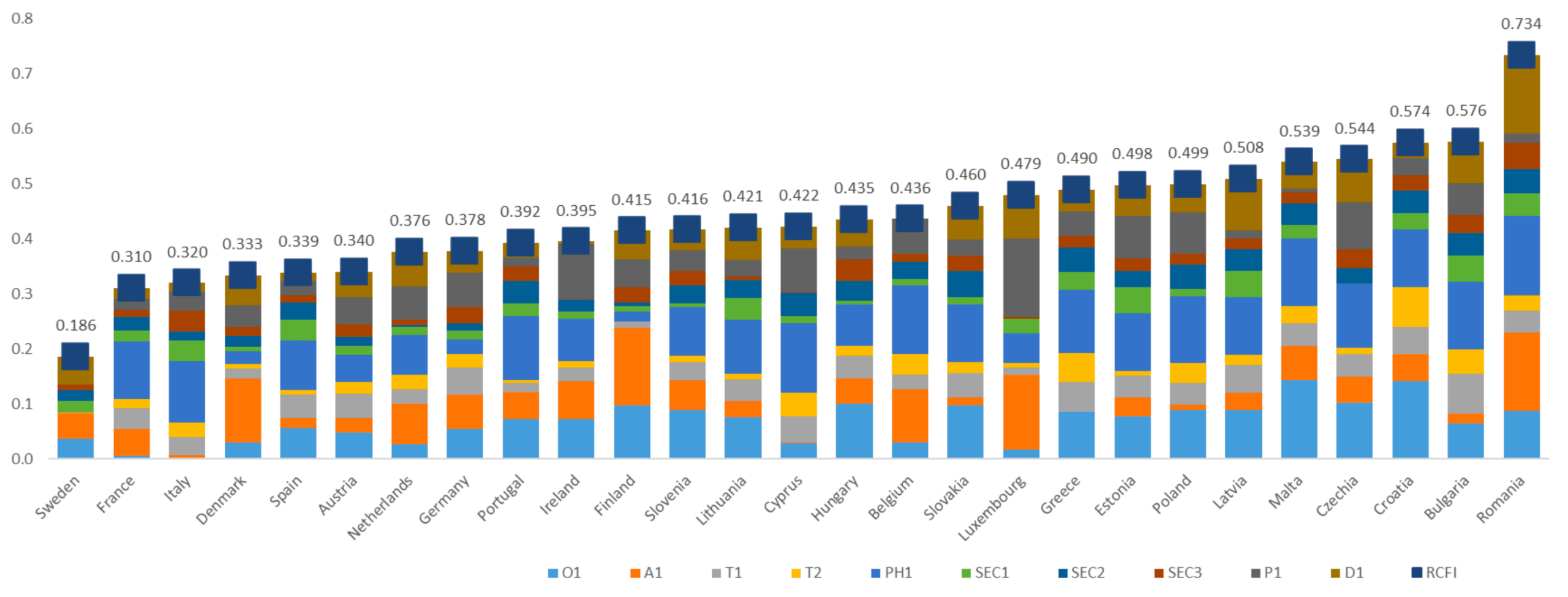
The country ranks among the highest-risk countries on the Cancer Risk Factors Index, a composite measure of obesity, tobacco and alcohol consumption, physical activity, socio-economic conditions, and pollution, placing it in the top tier alongside Romania, Hungary, and Slovakia. Healthcare expenditure stands at approximately 7.1% of GDP, with out-of-pocket payments accounting for around 35.5% of total health spending — the highest share in the EU. Preventive healthcare expenditure remains low, consistent with the pattern observed across high-CRFI countries. Under a comprehensive cancer control scenario combining prevention, screening, and treatment, the country could achieve estimated annual economic gains of EUR 32 million.
Cancer Risk Factor Index (CRFI) results
Relationship between Cancer Risk Factor Index (CRFI) and Cancer Mortality Rate
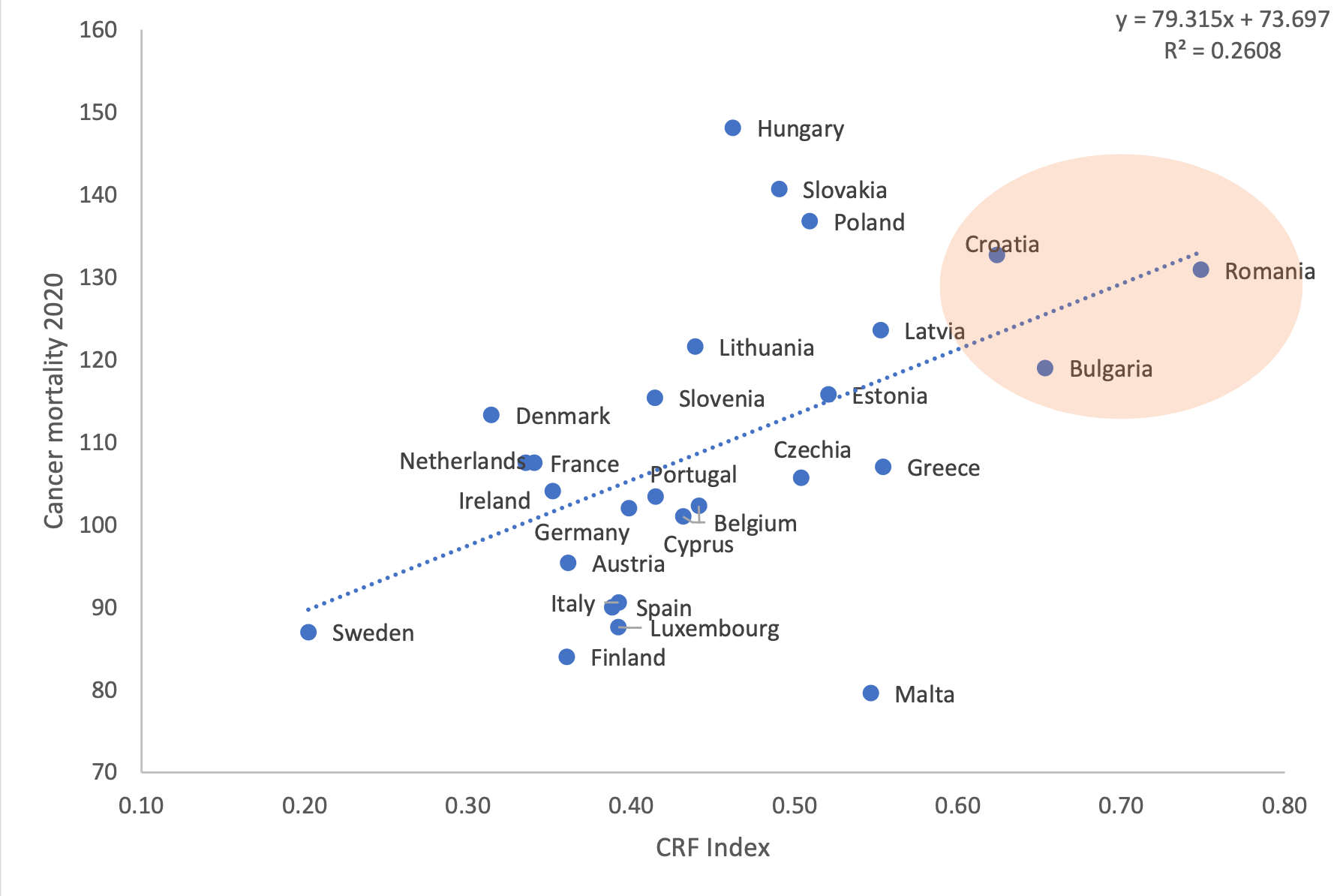
Cancer Risk Factor Index (CRFI) and Cancer Mortality Rate
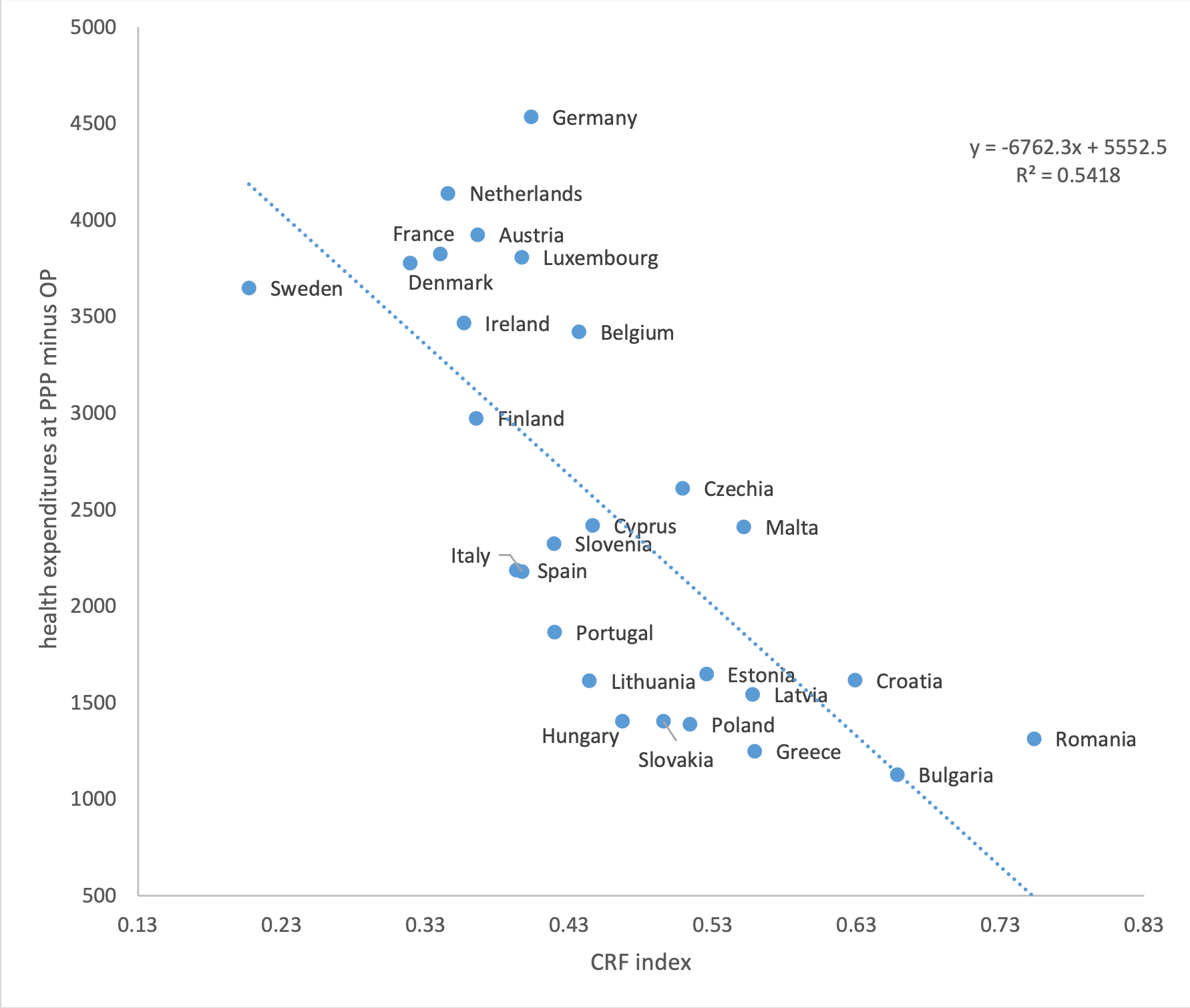
Cancer Prevention Literacy and Information on Cancer Primary Prevention
The data presented for the four EU and three non-EU countries are derived from commercial voluntary online panel surveys. The results are based on unweighted raw data and have not been calibrated to national census population benchmarks. They should not be interpreted as nationally representative prevalence estimates.
The survey questionnaires used in the EU and non-EU countries differ slightly. Consequently, results are not directly comparable between these groups of countries.
The survey questionnaires used in the EU and non-EU countries differ slightly. Consequently, results are not directly comparable between these groups of countries.