



Platform objectives

Integrate multi-source evidence
Bringing together policy, economic, behavioural data and survey results into a single, coherent resource.

Enable cross-country comparison
Supporting side-by-side analysis of cancer prevention indicators across seven European countries, surfacing East–West disparities.

Serve diverse stakeholders
Delivering tailored insights for policymakers, researchers, journalists, civil society, and the private sector through a shared platform.

Translate research into action
Bridging the gap between academic findings and practical decision-making in cancer primary prevention.

Promote data accessibility
Making complex, multi-level data navigable and interpretable — from European meta-level down to national and regional contexts.

Support evidence-based advocacy
Providing stakeholders with credible data to strengthen policy arguments, funding cases, and public communication.
Stakeholder benefits
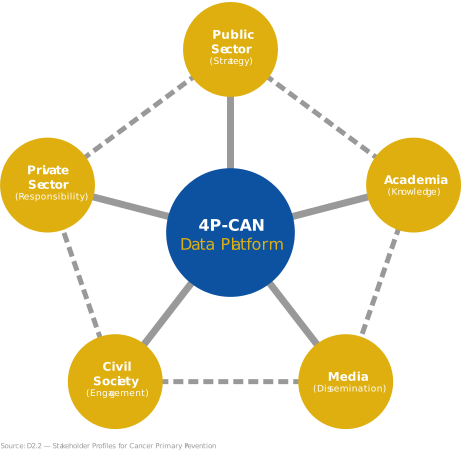

Public Sector
Access cross-country benchmarks and economic evidence to build the policy case for cancer prevention investment.

Academia & Research
Explore integrated, multi-source datasets and identify research gaps across seven countries in a single environment.

Media
Find credible, data-driven stories on cancer prevention with the context needed to report accurately and compellingly.

Civil Society
Ground advocacy in hard evidence — from community-level survey data to national policy gaps and economic burden figures.

Private Sector
Understand population health trends, regulatory landscapes, and the economic cost of inaction to inform responsible strategy.
Multi-Level Data Framework
The platform organises data across multiple geographic levels, from the continental scale to the individual.
The meta level provides the European-wide policy and regulatory context that frames each topic. The macro level presents national indicators, enabling direct comparison across the seven consortium countries — four EU Member States (Romania, Bulgaria, Italy, and Portugal) and three non-EU countries (Republic of Moldova, Montenegro, and North Macedonia). The meso level draws on subnational patterns from the “Cross-national survey on cancer prevention knowledge and behaviors” to reveal regional variation within countries. Finally, the micro level incorporates Living Lab data from Romania and Bulgaria, adding hyperlocal, community-specific insights as Phase 2 data becomes available. Together, these levels allow users to move fluidly between the broader European perspective and the realities on the ground.
The meta level provides the European-wide policy and regulatory context that frames each topic. The macro level presents national indicators, enabling direct comparison across the seven consortium countries — four EU Member States (Romania, Bulgaria, Italy, and Portugal) and three non-EU countries (Republic of Moldova, Montenegro, and North Macedonia). The meso level draws on subnational patterns from the “Cross-national survey on cancer prevention knowledge and behaviors” to reveal regional variation within countries. Finally, the micro level incorporates Living Lab data from Romania and Bulgaria, adding hyperlocal, community-specific insights as Phase 2 data becomes available. Together, these levels allow users to move fluidly between the broader European perspective and the realities on the ground.
META-LEVEL
NetMap Stakeholder Ecosystem Mapping
Network analysis of penta-helix actors across 7 countries
Data source: 4P-CAN NetMap exercise
MACRO-LEVEL
National aggregated data (WP2 / WP3 / T4.1)
Comparable international sources (e.g. Eurobarometer, GBD, EU Cancer Country Profiles, WHO)
Primary analysis level - 7 country profiles with policy, economic, and survey data
MESO-LEVEL
Regional level
Data aggregated nationally; regional specificities to be explored in correlation with T4.2 / T4.3 campaign findings
Demographic filtering (gender, age) available as proxy for subgroup analysis
MICRO-LEVEL
Human stories from WP5 Living Labs
Qualitative citizen narratives (Romania, Bulgaria)
Discussing the human behind the dots - humanising data and connecting people with statistics
Information Architecture
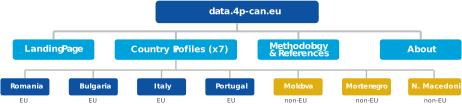
The platform is structured around five core sections: a landing page introducing the platform's purpose and stakeholder framework; seven country profile pages — one per consortium country — each presenting T4.1 survey results, WP2 policy indicators, and WP3 economic burden data in a consistent, comparable format; an about page explaining the project context, methodology, and data sources; and a methodology and references page providing full documentation of analytical frameworks and source materials. This architecture was designed to support both focused, single-country exploration and broader cross-country discovery, with each country page following a shared template that makes comparison intuitive.